Fukushu Changshou
Fortunella obovata hort. ex Tanaka
CRC 3475
PI 539730
VI 805 (Different source)
Source
Received as seed from Okitsu, Shizuoka Pref., Japan (via W.P. Bitters, CRC), 1963.
Parentage/origins
Considered to be a chance hybrid between two of the Fortunella species.
Rootstocks of accession
Carrizo citrange
Season of ripeness at Riverside
Year-round
Season of flowering at Riverside
May to September
Notes and observations
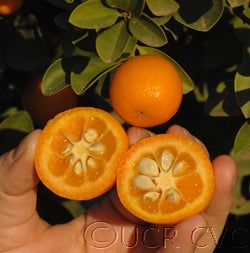
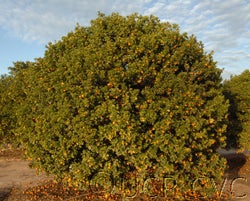
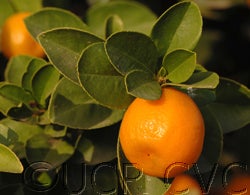
Changshou kumquat, Fortunella obovata, is also called the Fukushu kumquat in Japan. The naturally small tree is very ornamental, has a spreading form, and is thornless. The leaves are larger and broader than other kumquat species. The fruit is also larger and slightly different in shape. Changshou is about one and one-half inches long and oval with a depressed apex. The rind is orange and thinner than Nagami or Meiwa. The flesh is orange, acidic, and contains a few seeds.
Notes from W.P. Bitters' 1963 trip to Japan: Polyembryonic. Light yellow-orange rind, smooth bell-shaped fruit, aobut 1 to 1&1/2" long, 3/4" wide, stylar end depressed, stem end rounded, flesh orange colored, central core solid, 8-10 seeds, extremely large. Rind is sweet but somewhat acrid from high oil content. This is probably a hybrid. Introduced seeds for ornamental purposes. F. obovata is described as Changshou kumquat in TCI.
11/1988, EMN: Large fruit for a kumquat, sour flesh & juice. Fairly attractive tree, may have ornamental value.
Description from The Citrus Industry Vol. 1 (1967)
"The Choju kinkan or Changshou or Fukushu kumquat of Japan is a dwarf variety that is reported to be widely grown as a potted plant in China and also in Japan to some extent. According to Swingle, it is characterized by the broadly obovate form of the fruit, a markedly depressed apex, medium size, thin rind (for a kumquat), and a rather large number of segments (five or six, sometimes as many as eight). Seeds are usually few and polyembryonic. The plant is small and thornless.
This species was established by Tanaka (1933, p. 38) but was not accepted by Swingle who considered it to be a chance hybrid between two of the Fortunella species."
Availability
A different budwood source is commercially available in California through the Citrus Clonal Protection Program. Click here to order budwood.
USDA Germplasm Resources Information Network page for Fukushu kumquat